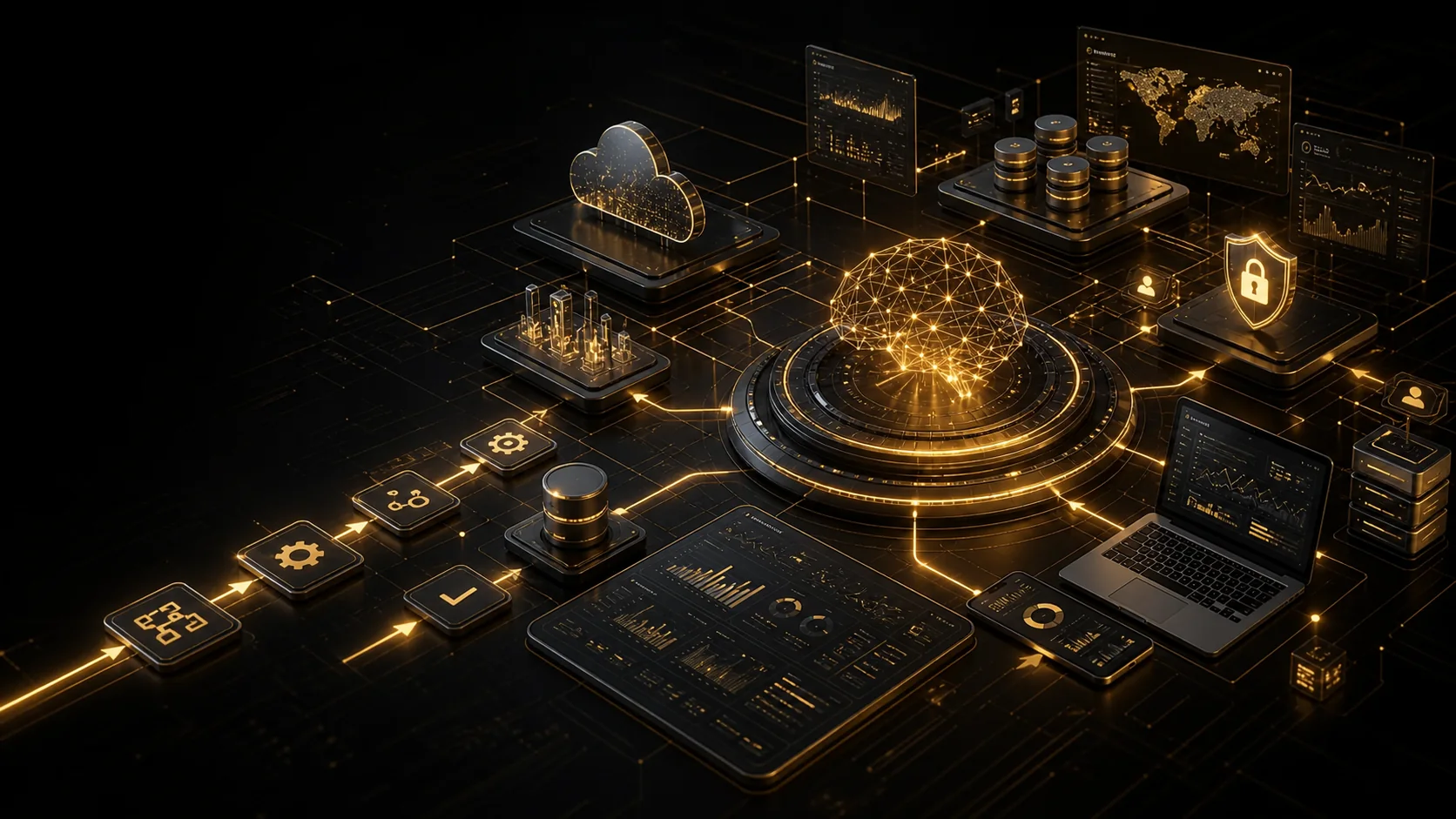
Growing businesses often reach a point where the old tools start fighting the team. Orders live in messages. Stock lives in spreadsheets. Approvals happen verbally. Reports are assembled manually. Customer records are scattered across emails, notebooks, and apps that do not talk to each other.
Custom software becomes valuable when it turns that scattered work into one reliable operating system.
When custom software is worth it
Custom software is not always the answer. If an off-the-shelf product fits the workflow well, use it. But when the business process is specific, revenue-critical, or difficult to manage with generic tools, custom software can become a serious advantage.
- Transport booking and fleet operations.
- Retail POS and inventory workflows.
- Church apps, events, media, and member engagement.
- Ecommerce catalogues, delivery, trade accounts, and order tracking.
- Dashboards, approvals, records, reporting, and client portals.
Where AI fits
AI should be attached to a real business problem, not added as a decoration. Strong AI use cases include document processing, internal knowledge search, customer support assistance, report summarization, routing, fraud signals, forecasting, content classification, and workflow recommendations.
The safest AI projects start with clean data, clear boundaries, human oversight, and measurable outcomes.
Automation works best when systems are connected
Automation fails when the underlying systems are still disconnected. If your website, app, payment system, CRM, inventory tool, and reporting dashboard do not share data, the team will still copy and paste information manually.
Integration is what turns automation from a nice demo into a dependable business workflow.
Examples of useful automation
- Turn website enquiries into CRM leads and follow-up tasks.
- Notify customers when orders, bookings, or payments change status.
- Generate operational reports from live data.
- Route support requests to the right team.
- Flag unusual activity before it becomes a bigger problem.
What makes the system maintainable?
Maintainable software has clear architecture, role-based access, documentation, testing, backups, monitoring, secure deployment, and a support plan. The goal is not simply to build more screens. The goal is to make the business easier to operate, measure, secure, and scale.
How Ophiron approaches it
Ophiron designs custom software, AI-enabled workflows, cloud platforms, secure dashboards, mobile apps, ecommerce systems, and enterprise integrations around practical business outcomes. We focus on systems that teams can actually use and leaders can trust.